Free 4-20mA & 0-10V Analog Scaling Calculator
Convert raw PLC counts to engineering units in seconds. Pick your platform (Siemens, Allen-Bradley, Beckhoff, CODESYS), enter the signal range and EU range, and get the slope, offset and ready-to-paste PLC code — with NAMUR NE43 fault thresholds and a transfer-function chart.
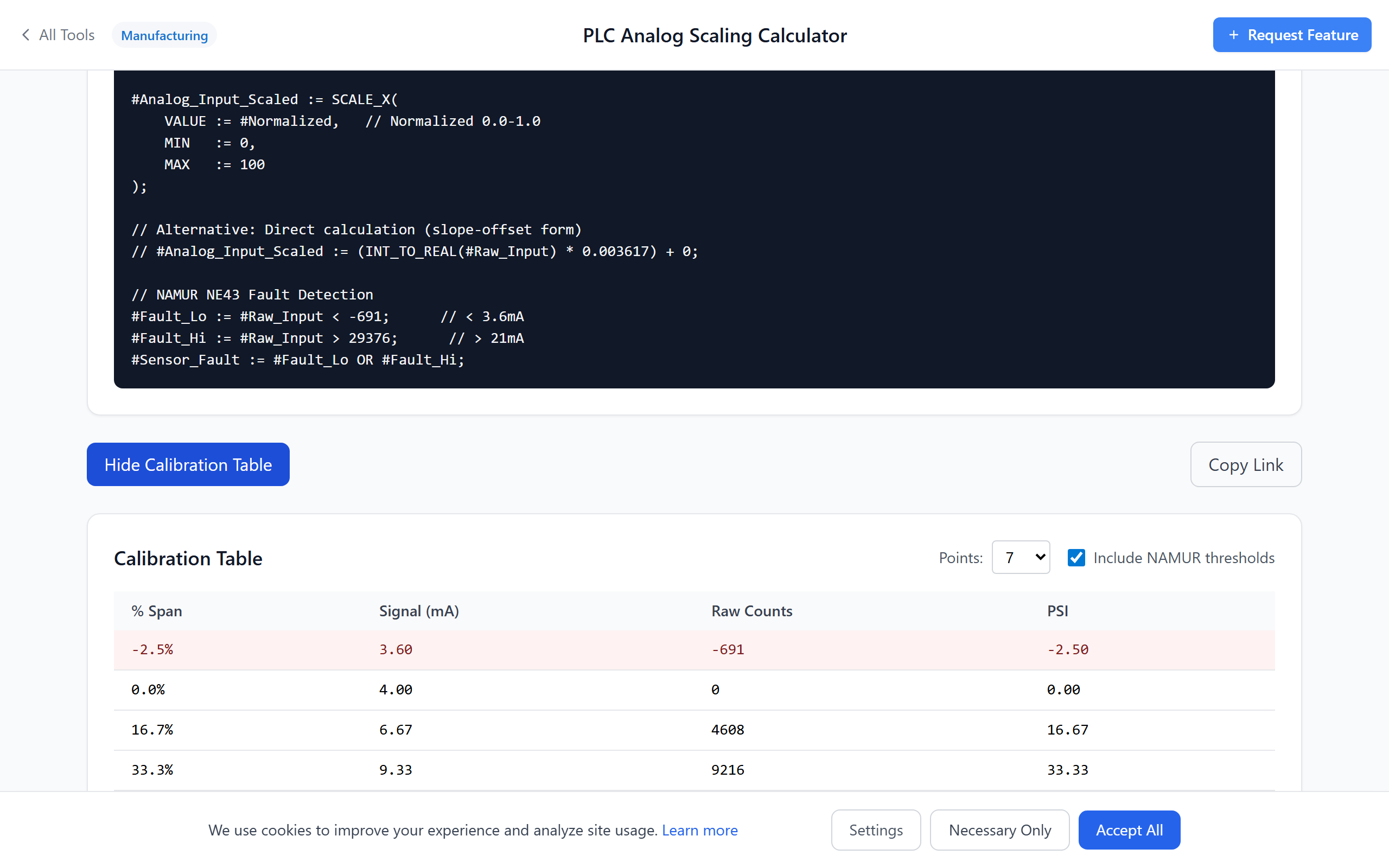
Slope, Offset & PLC Code — In One Click
Raw Counts ↔ Engineering Units
Linear conversion between raw module counts and PSI, °C, bar, %, GPM — whatever your tag uses. Inverted (fail-safe) signals supported.
4-20mA, 0-10V, ±10V & More
Nine standard signal types covered, with custom ranges for non-standard sensors and the unusual 1-5V live-zero loops.
NAMUR NE43 Fault Detection
Automatic fault (3.6 mA) and warning (3.8 mA / 20.5 mA / 21 mA) thresholds for broken-loop detection — visualised on the transfer-function chart.
Transparent Slope & Offset
See the exact m and b values plus the formula EU = m × raw + b. Resolution and counts-per-EU shown alongside.
Generates PLC Code
Siemens SCL with NORM_X / SCALE_X, Allen-Bradley Structured Text, Beckhoff TwinCAT, CODESYS — paste straight into your project.
Runs Locally
Browser-only, no signup, no server, no upload. Works offline once loaded. Share configurations with a copy-able URL.
Built for PLC Commissioning
Platform Presets — Siemens, Allen-Bradley, Beckhoff, CODESYS
Pick your PLC and the raw-count ranges fill in automatically: Siemens S7 (0–27648), Allen-Bradley ControlLogix (3277–16384 for 4-20mA), Beckhoff TwinCAT (0–32767), AB PLC-5/SLC-500 legacy, and a custom platform for anything else.
- Siemens S7-300/400/1200/1500 — SM331 / AI modules, 0-27648 range
- Allen-Bradley ControlLogix / CompactLogix — 1756-IF8, 1769-IF4
- Allen-Bradley PLC-5 / SLC-500 — legacy 0-16383 range
- Beckhoff TwinCAT — 0-32767 / ±32768 ranges
- CODESYS, custom & manual range entry
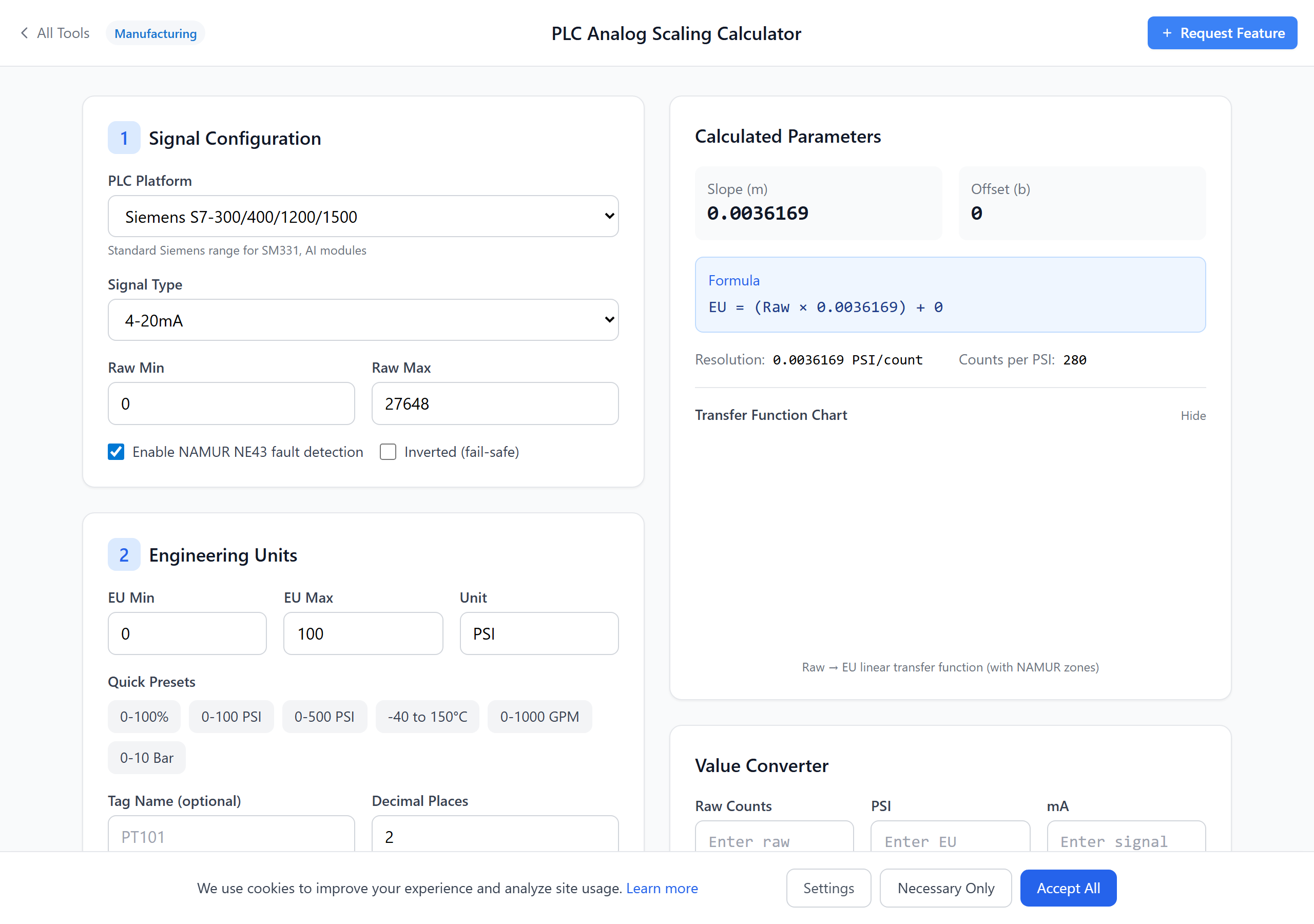
NAMUR NE43 Fault Detection & Transfer-Function Chart
For 4-20mA loops the calculator computes the NAMUR NE43 fault (3.6 mA / 21 mA) and warning (3.8 mA / 20.5 mA) thresholds in raw counts and engineering units, and highlights the valid / warning / fault zones on the transfer-function chart.
- Fault thresholds in raw counts and EU
- Valid range, warning low/high, fault low/high
- Live status: OK / Warning / Fault on the converter
- Annotated zones on the linear transfer-function chart
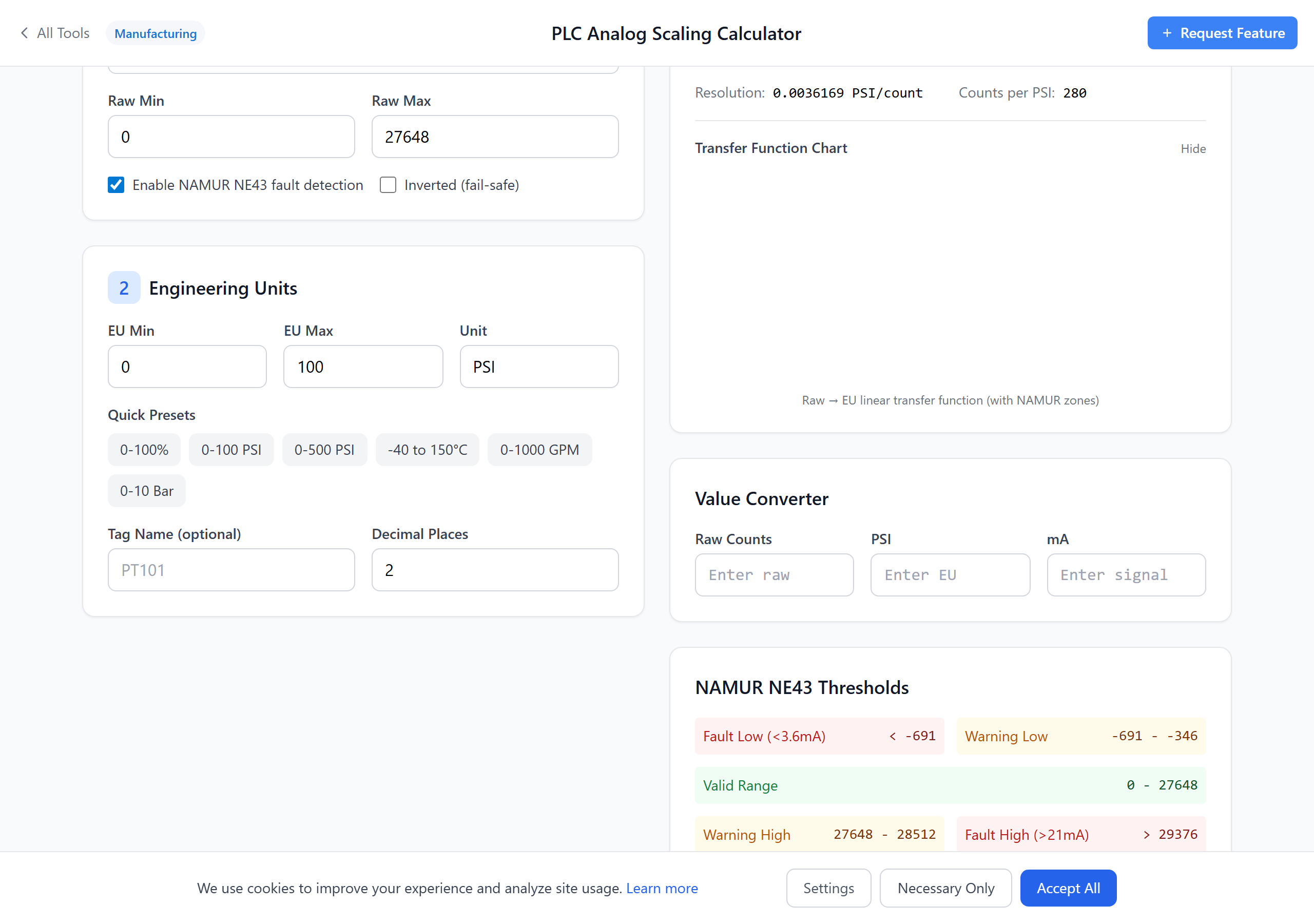
Code Generation — SCL, Structured Text, CODESYS
Once the math is locked in, hit Copy or Download to get a ready-to-paste code block in your platform's language: Siemens SCL using NORM_X / SCALE_X, Allen-Bradley Structured Text with SCP-style scaling, Beckhoff function blocks, CODESYS — all with NAMUR fault handling stubbed in if enabled.
- Siemens SCL — NORM_X + SCALE_X with tag names
- Allen-Bradley Structured Text — SCP-style scaling
- Beckhoff TwinCAT 3 function blocks
- CODESYS ST
- Copy to clipboard or download as .scl / .st / .iecst
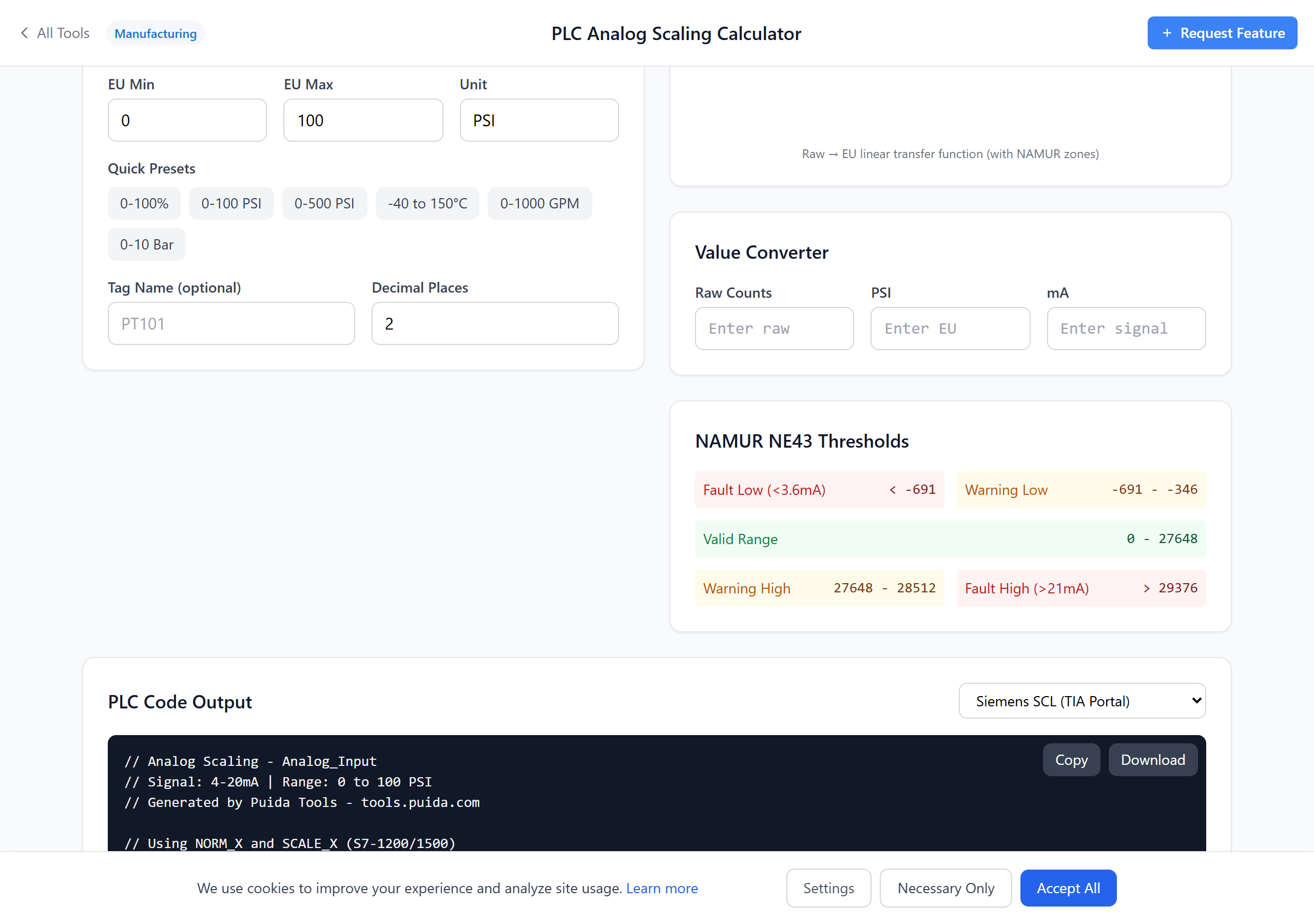
Analog Scaling FAQ
Or equivalently EU = m × raw + b with:
• slope m = (EU_max − EU_min) ÷ (raw_max − raw_min)
• offset b = EU_min − m × raw_min
For Siemens S7 the raw range is 0–27648, for Allen-Bradley ControlLogix at 4-20mA it is 3277–16384, for Beckhoff TwinCAT it is 0–32767. Plug those into the formula and you get the slope/offset to drop into NORM_X/SCALE_X or SCP.
EU := (Raw - 3277) * (EUMax - EUMin) / (16384 - 3277) + EUMin;.With NE43 enabled, this calculator shows the threshold counts and highlights the zones on the transfer-function chart so your PLC logic stays consistent across projects.
On Siemens the raw range is still 0–27648 (0 V = 0, 10 V = 27648). On Allen-Bradley ControlLogix 0–10 V maps to 0–32767. Pick "0-10V" as the signal type in the calculator and the raw range fills in for your platform.
1. Wrong raw range — 0–32767 (Beckhoff) vs 0–27648 (Siemens) vs 3277–16384 (AB 4-20mA) are easy to mix up.
2. Clamping before scaling — if you limit the raw value to 0–27648 before scaling, you lose NAMUR diagnostic information.
3. Integer overflow — slope and offset on small integer types overflow; use REAL/FLOAT for the math.
4. Inverted signal — for fail-safe loops a wire break should park the value at min, not max. Use the inverted option.
5. Filter / debounce settings on the AI module can mask the symptom you are seeing on the screen.
4-wire (separately powered): two wires for power (24 VDC, 120 VAC), two for signal. Used when the sensor needs more current than the loop can supply — flow meters, gas detectors, some pH analysers. Scaling math is the same either way; only the wiring differs.
Get Your Analog Scaling Right the First Time
Free. Generates PLC code. NAMUR NE43 built in. No signup.
Open Scaling Calculator