Cable Size & Wire Gauge Calculator
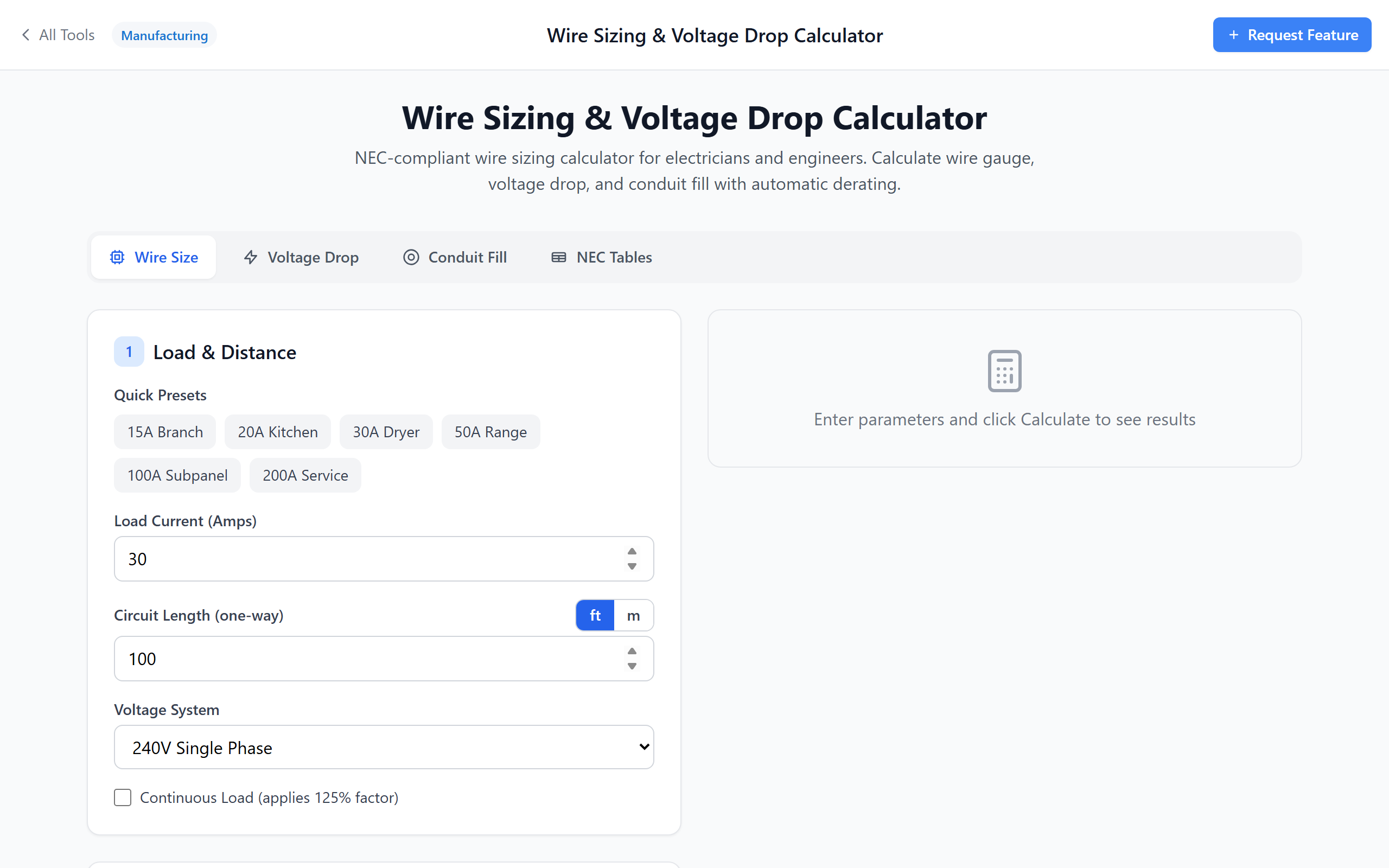
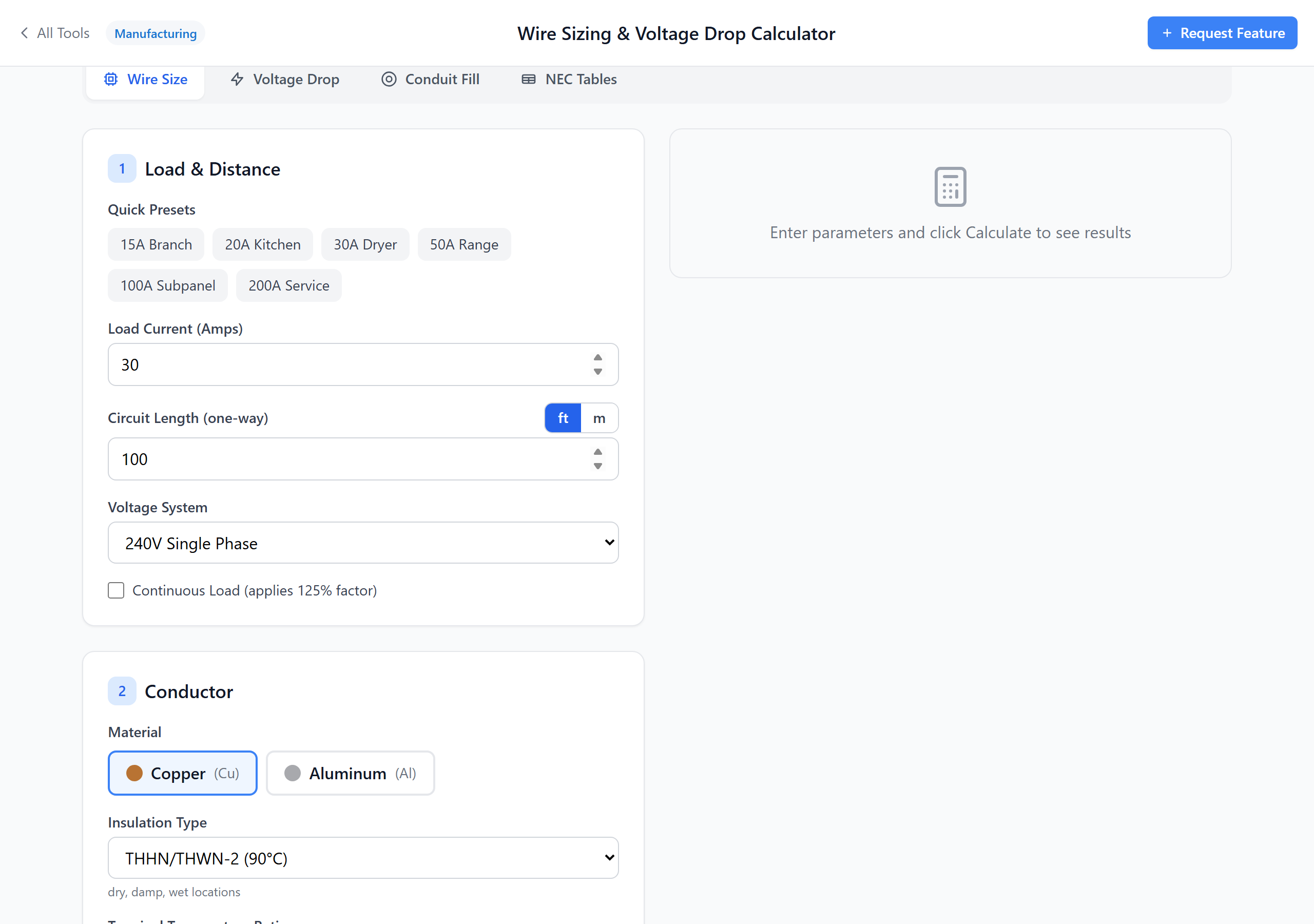
Enter amps, distance and voltage — get the right cable size, wire gauge and voltage drop instantly. Copper or aluminium. Single-phase, 3-phase and 12V/24V/48V DC. AWG and mm². NEC, BS 7671 and IEC references.
One Tool for AC, DC, AWG and mm²
Voltage Drop Calculator
Single-phase, 3-phase and DC voltage drop. Stay within the 3 % branch and 5 % total limits used by NEC, BS 7671 and IEC.
Cable Size in Seconds
Get a recommended cable size and wire gauge from load amps, run length and voltage system — with ampacity and derating already applied.
AWG ↔ mm² Built In
Convert between American AWG / kcmil and metric IEC 60228 mm² sizes. Cross-section, diameter and approximate ampacity side by side.
DC: Solar, Marine, RV, 12V/24V/48V
Dedicated 12V, 24V and 48V DC voltage systems for solar, marine, RV and low-voltage lighting — where voltage drop matters most.
Conduit Fill & Derating
NEC conduit fill for EMT, IMC and rigid raceway. Temperature correction and bundling adjustment factors applied automatically.
Private & Offline
Runs entirely in your browser. No account, no upload, no tracking. Works offline after the first load.
Built for Real Cable Sizing Work
Cable & Wire Size Calculator With Ampacity and Derating
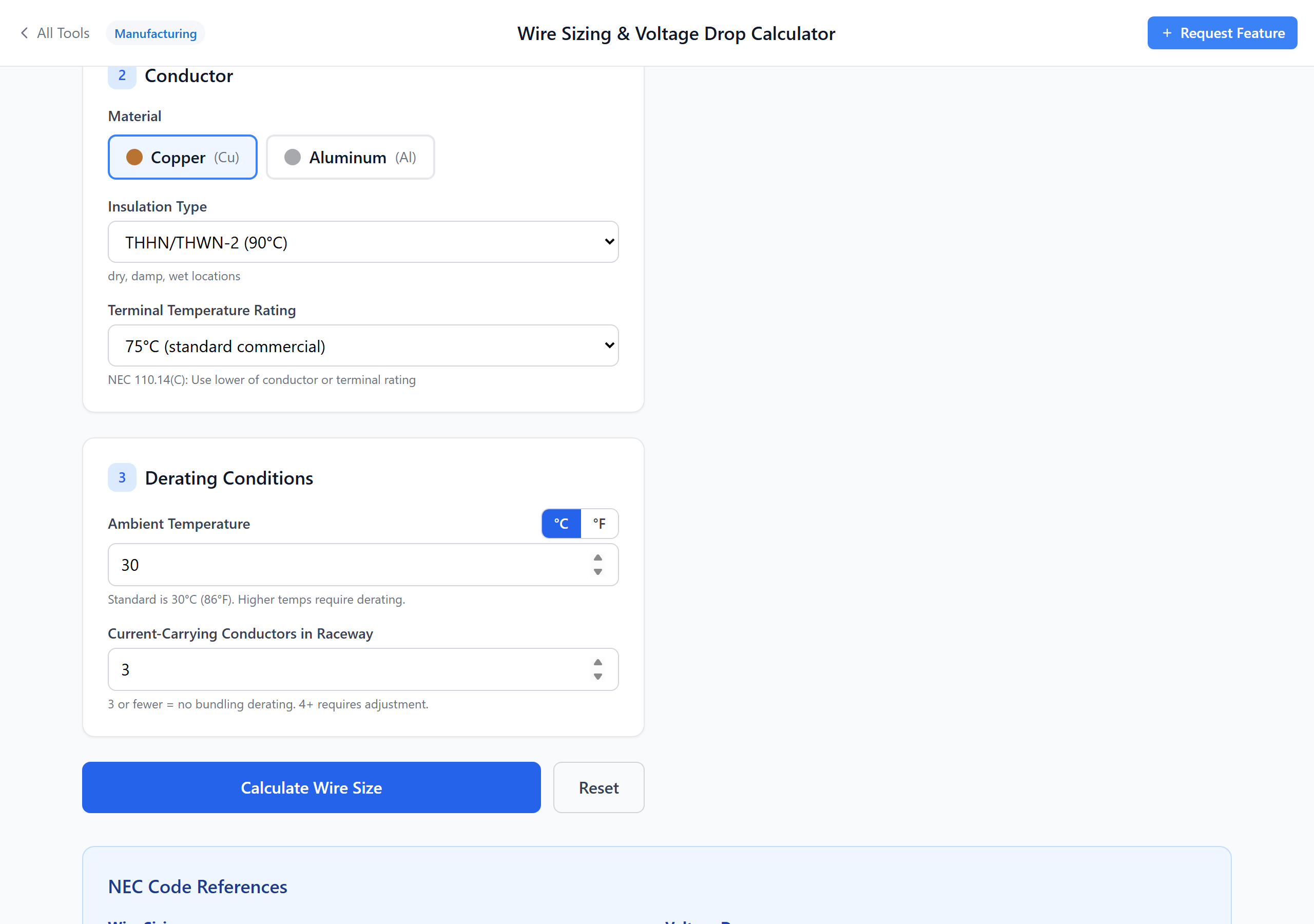
Pick load current, distance and voltage system — the calculator returns the minimum cable size that satisfies ampacity, temperature derating, conductor bundling and the 125 % continuous-load factor. Works for copper and aluminium.
- NEC Table 310.16 ampacity at 60 / 75 / 90 °C
- Temperature correction (Table 310.15(B)(1))
- Bundling adjustment for 4+ conductors (Table 310.15(C)(1))
- Continuous-load 125 % factor per 210.20(A) / 215.3
- Cross-reference to IEC 60228 mm² standard sizes
Voltage Drop Calculator — AC, 3-Phase and DC
Calculate voltage drop in volts and percent for single-phase, three-phase and DC circuits. Compare conductor sizes to find the most economical cable that stays inside the 3 % branch / 5 % total recommendation.
- Single-phase: VD = 2 × I × R × L ÷ 1000
- Three-phase: VD = √3 × I × R × L ÷ 1000
- DC: same as single-phase, with proper return-conductor factor
- Copper and aluminium resistance per NEC Chapter 9, Table 8
- Distance in feet or metres, °C or °F ambient
AWG ↔ mm² Reference & Conduit Fill
Built-in AWG to mm² converter with the full reference table — area, diameter and the nearest IEC 60228 standard cable size. Conduit fill calculator for EMT, IMC, rigid and PVC raceways.
- AWG / kcmil ↔ mm² conversion (IEC 60228)
- Conductor diameter in mm and inches
- Approximate ampacity for copper and aluminium
- EMT, IMC, RMC and PVC conduit fill per NEC Chapter 9
- Neutral conductor sizing notes for harmonic-rich loads
Cable Size Charts & Reference Tables
Quick-reference cable and wire size charts based on NEC Table 310.16, with AWG ↔ mm² conversion and the standard used in each region. Use these to sanity-check the calculator — always confirm against your local code and the actual run length.
What size wire for each amp rating? (copper, aluminium, metric)
| Load / Breaker | Copper (AWG) | Aluminium (AWG) | Metric (mm²) |
|---|---|---|---|
| 15 A | 14 AWG | 12 AWG | 1.5 mm² |
| 20 A | 12 AWG | 10 AWG | 2.5 mm² |
| 30 A | 10 AWG | 8 AWG | 4 mm² |
| 40 A | 8 AWG | 8 AWG | 6 mm² |
| 50 A | 6 AWG | 6 AWG | 10 mm² |
| 60 A | 6 AWG | 4 AWG | 16 mm² |
| 100 A | 3 AWG | 1 AWG | 25 mm² |
| 150 A | 1/0 AWG | 3/0 AWG | 50 mm² |
| 200 A | 3/0 AWG | 250 kcmil | 70 mm² |
Copper and aluminium sizes are the smallest NEC Table 310.16 conductor at the 75 °C column that meets the load, with 240.4(D) small-conductor limits applied. Dwelling services and feeders may use smaller conductors under NEC 310.12 (e.g. 200 A → 2/0 AWG copper or 4/0 AWG aluminium). Long runs often need upsizing for voltage drop. Metric is the nearest IEC 60228 size — verify against BS 7671 / IEC 60364 installation method.
NEC Table 310.16 ampacity (amps, 30 °C ambient, ≤3 conductors)
| Size (AWG/kcmil) | Cu 60 °C | Cu 75 °C | Cu 90 °C | Al 75 °C | Al 90 °C |
|---|---|---|---|---|---|
| 14 | 15 | 20 | 25 | — | — |
| 12 | 20 | 25 | 30 | 20 | 25 |
| 10 | 30 | 35 | 40 | 30 | 35 |
| 8 | 40 | 50 | 55 | 40 | 45 |
| 6 | 55 | 65 | 75 | 50 | 55 |
| 4 | 70 | 85 | 95 | 65 | 75 |
| 3 | 85 | 100 | 115 | 75 | 85 |
| 2 | 95 | 115 | 130 | 90 | 100 |
| 1 | 110 | 130 | 145 | 100 | 115 |
| 1/0 | 125 | 150 | 170 | 120 | 135 |
| 2/0 | 145 | 175 | 195 | 135 | 150 |
| 3/0 | 165 | 200 | 225 | 155 | 175 |
| 4/0 | 195 | 230 | 260 | 180 | 205 |
| 250 | 215 | 255 | 290 | 205 | 230 |
| 350 | 260 | 310 | 350 | 250 | 280 |
| 500 | 320 | 380 | 430 | 310 | 350 |
Match the column to your terminal temperature rating per NEC 110.14(C) — most breakers under 100 A terminate at 60 °C or 75 °C even when the wire is rated 90 °C. Apply temperature and bundling derating on top of these values.
AWG ↔ mm² conversion chart
| AWG / kcmil | Area (mm²) | Diameter (mm) | Nearest IEC size |
|---|---|---|---|
| 14 AWG | 2.08 | 1.63 | 2.5 mm² |
| 12 AWG | 3.31 | 2.05 | 4 mm² |
| 10 AWG | 5.26 | 2.59 | 6 mm² |
| 8 AWG | 8.37 | 3.26 | 10 mm² |
| 6 AWG | 13.3 | 4.11 | 16 mm² |
| 4 AWG | 21.2 | 5.19 | 25 mm² |
| 2 AWG | 33.6 | 6.54 | 35 mm² |
| 1 AWG | 42.4 | 7.35 | 50 mm² |
| 1/0 AWG | 53.5 | 8.25 | 50 mm² |
| 2/0 AWG | 67.4 | 9.27 | 70 mm² |
| 3/0 AWG | 85.0 | 10.4 | 95 mm² |
| 4/0 AWG | 107 | 11.7 | 120 mm² |
| 250 kcmil | 127 | 12.7 | 120–150 mm² |
Cross-sectional area from the standard AWG formula. AWG and mm² are not exact matches — when converting, step up to the next standard size rather than down.
Cable sizing standard by region
| Region | Standard | Sizing basis |
|---|---|---|
| USA / Canada | NEC (NFPA 70) Table 310.16 | AWG / kcmil, 60 / 75 / 90 °C ampacity |
| United Kingdom | BS 7671 (IET Wiring Regs) App. 4 | mm², Reference Methods A–F |
| Australia / NZ | AS/NZS 3008.1 | mm², installation method + derating |
| Europe / Intl. | IEC 60364-5-52 | mm², IEC 60228 conductor classes |
This calculator sizes to NEC Table 310.16 (the most-searched standard) and shows the nearest IEC 60228 mm² size. For BS 7671, AS/NZS 3008 or full IEC 60364 designs, confirm against the local current-carrying-capacity tables — ratings can differ by up to ~20 % depending on installation method.
Cable Sizing FAQ
Single-phase / DC: VD = 2 × I × R × L ÷ 1000 Three-phase: VD = √3 × I × R × L ÷ 1000
Where I = amps, R = Ω/kft (NEC Ch. 9 Table 8), L = one-way length in feet. Industry rule of thumb is 3 % maximum for branch circuits and 5 % total (feeder + branch). The calculator above does this automatically for AC and DC systems.