Reef Dosing Calculator
Brand-agnostic dosing for alkalinity, calcium, magnesium, nitrate and phosphate. Enter your own concentrations, build DIY two-part stocks, track consumption, and get doser-pump schedules — with every formula and source shown. Free, no login, your data stays on your device.
One Calculator for Your Whole Reef Chemistry Workflow
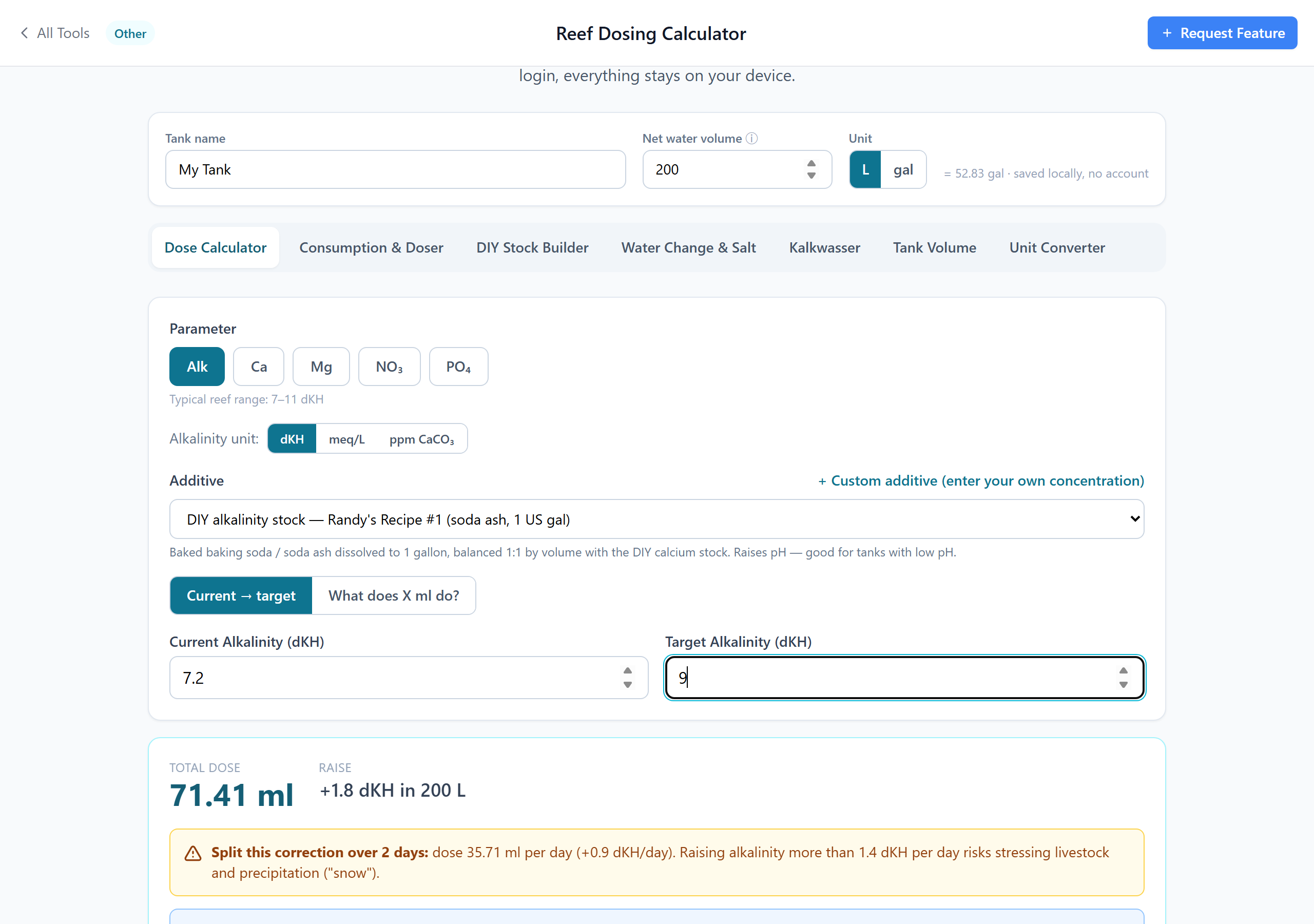
Dose Any Additive
Alk, Ca, Mg, NO₃ and PO₄ in both directions: current → target, or "what does 10 ml actually do?" Works with DIY chemicals and any brand via custom concentrations.
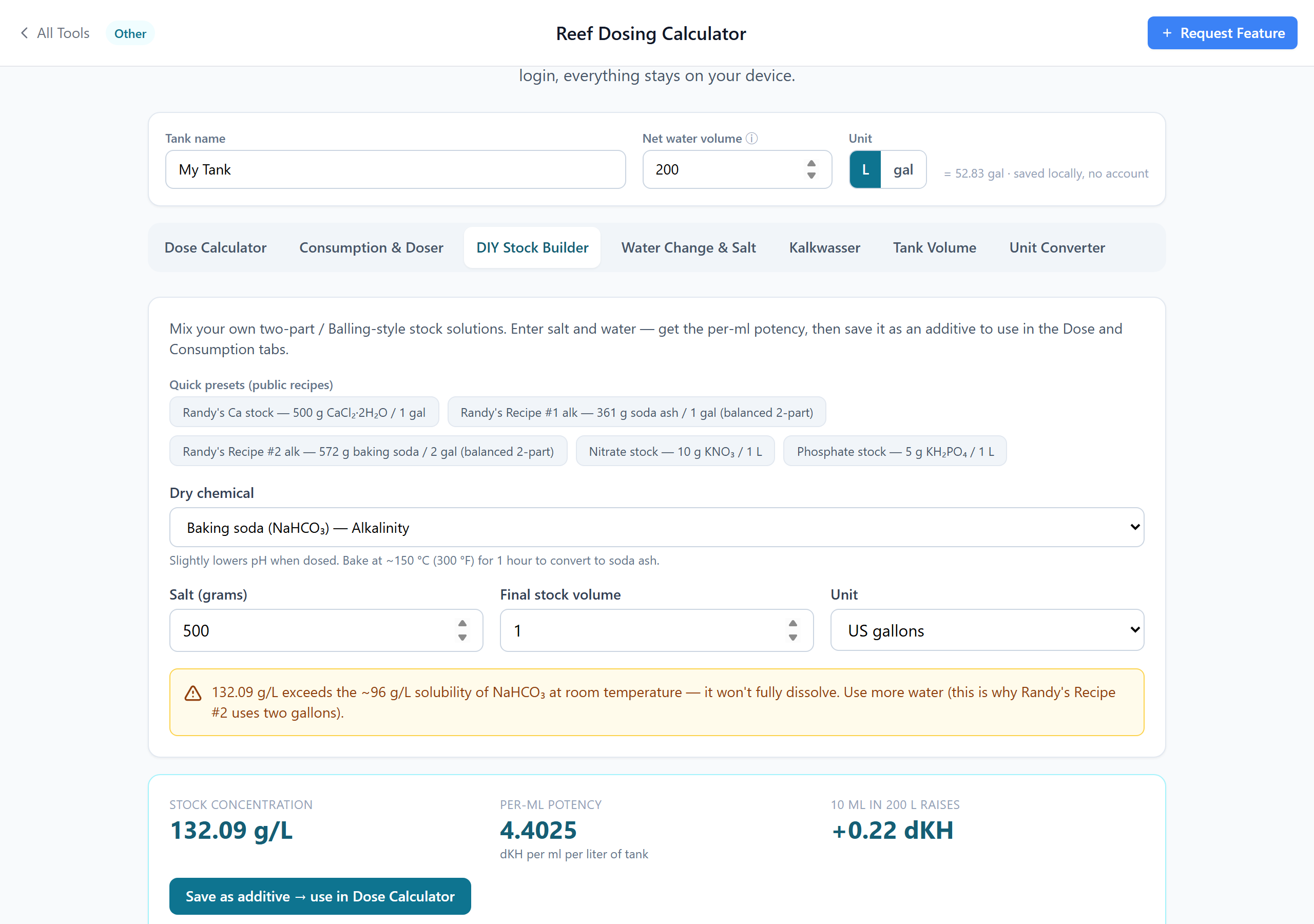
DIY Two-Part & Balling Builder
Grams of salt + water → per-ml potency, fed straight back into the dose calculator. Randy's Recipes #1 and #2 built in, with solubility warnings.
Consumption → Standing Dose
Two tests a few days apart become your daily consumption rate and the standing daily dose that holds parameters steady — plus a doser-pump schedule.
Safety Built In
Auto dose-splitting for corrections over 1.4 dKH/day, Ca+Alk precipitation warnings, kalkwasser pH-spike alerts, and net-volume math so you never dose against gross volume.
Show the Math
Every result has an expander with the formula, constants, and source — grounded in Randy Holmes-Farley's published reef chemistry articles.
No Login, Offline, Private
Everything runs in your browser and saves to your device. No account, no upload, no subscription. Works at the tank with no signal.
Built to Replace the Calculator the Hobby Lost
Dose Calculator — Both Directions, Any Brand
Pick a parameter, pick an additive (or enter your own concentration the way labels state it), and get the exact ml or grams. Reverse mode tells you what a given dose will change. Corrections that exceed safe daily limits are automatically split across days.
- Alkalinity in dKH, meq/L or ppm CaCO₃ (1 meq/L = 2.8 dKH = 50 ppm)
- DIY chemicals built in: soda ash, baking soda, calcium chloride, magnesium chloride/Epsom blend, KNO₃, NaNO₃, KH₂PO₄, TSP
- Custom additive entry: "X ml in Y gallons raises Z" — stored locally
- BRS-style dose splitting over 1.4 dKH/day; gentle 0.5 dKH/day guidance
- Never-dose-Ca-and-Alk-together and low-Mg-first warnings
DIY Stock Builder + Consumption Tracking
Build two-part and Balling-style stock solutions from dry salts and feed the resulting potency straight into the doser. Then measure your tank's daily consumption from two dated tests and get the standing dose and pump schedule that hold it steady.
- Randy's Ca stock (500 g CaCl₂·2H₂O/gal ≈ 36,000 ppm) and balanced alk recipes
- Solubility warnings (why Recipe #2 needs two gallons)
- Consumption = (test 1 − test 2) ÷ days + existing dosing
- ml/day → ml-per-dose × doses/day with evenly spaced times
- Minimum-pump-volume warnings for tiny doses
Water Change, Salt Mix, Kalkwasser & Tank Volume
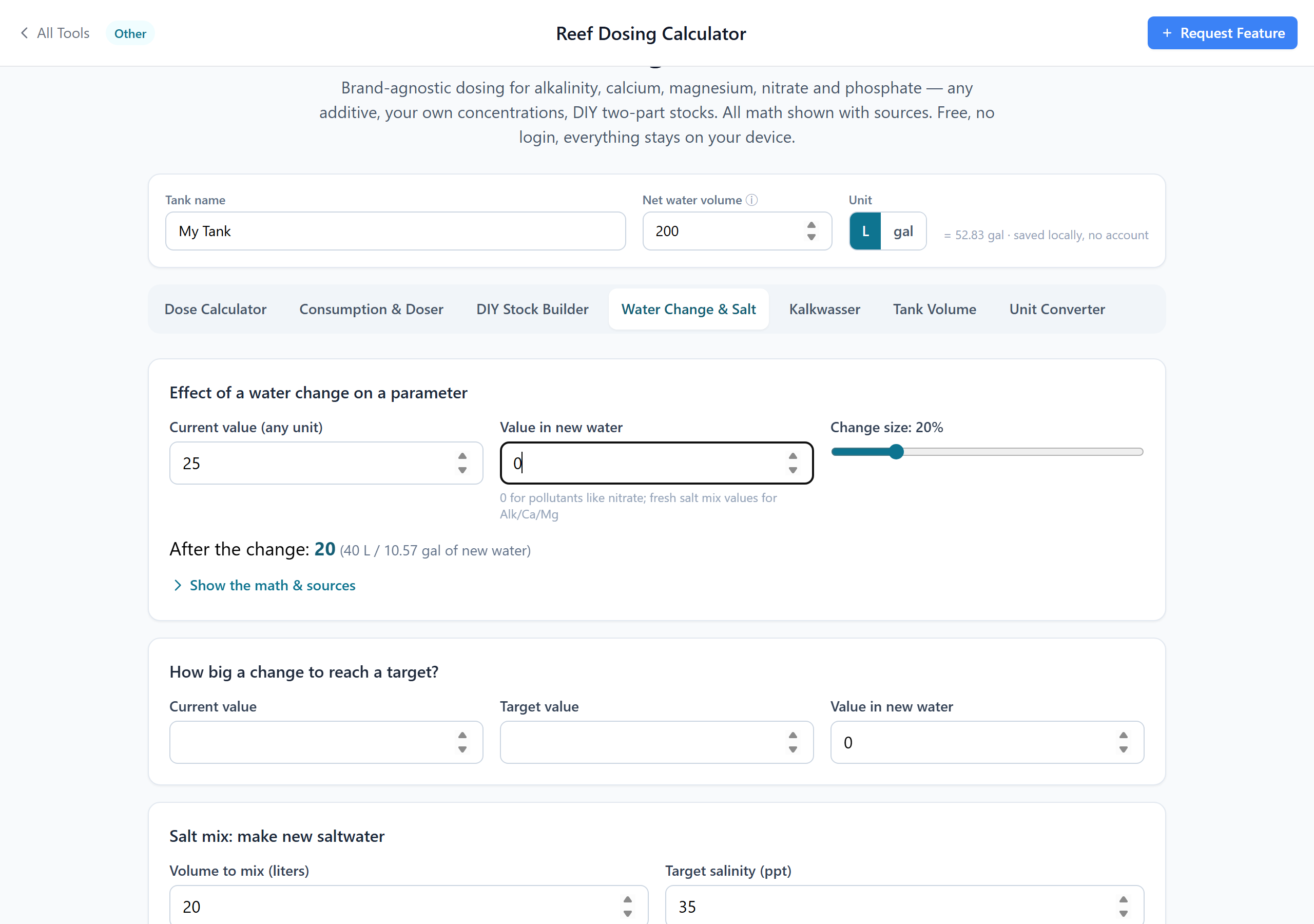
The adjacent math every reefer needs: dilution effects of water changes, how big a change reaches a target, salt mix amounts, salinity correction, kalkwasser dosing from RHF constants, and net water volume with rock/sand displacement.
- Water change: C = C₁(1−f) + C₂·f, single or repeated changes
- Salt mix grams for any volume and salinity target
- Kalkwasser: saturated = 40.8 meq/L, ~808 ppm Ca, pH 12.54 (RHF)
- Net volume = gross × fill % × (1 − displacement %) + sump
- Unit converter: dKH ↔ meq/L ↔ ppm CaCO₃, SG ↔ ppt ↔ mS/cm, gal ↔ L
Reef Dosing FAQ
Stop Guessing Your Doses
Any additive, all the math shown. Free. No signup.
Open Reef Dosing Calculator